Meta Description: Discover how e-commerce fulfillment services help online stores reduce costs, improve delivery speed, and scale faster with reliable 3PL solutions.
E-Commerce Fulfillment Services: The Secret Behind Fast-Growing Online Stores
Running an online store sounds exciting until your living room starts looking like a warehouse.
One minute you’re celebrating your first 20 orders. The next, you’re surrounded by shipping boxes, packing tape, inventory spreadsheets, and customer emails asking, “Where’s my package?”
I’ve seen countless business owners reach this point. Whether you’re selling handmade candles, fashion products, toys, electronics, or pet supplies, there comes a time when managing orders yourself starts slowing down your growth.
That’s where e-commerce fulfillment services step in.
Instead of spending your evenings printing shipping labels and counting inventory, you can hand those tasks to professionals and focus on growing your brand.
In this guide, we’ll explore everything you need to know about order fulfillment solutions, third-party logistics (3PL) services, and the tools that make modern e-commerce run smoothly.
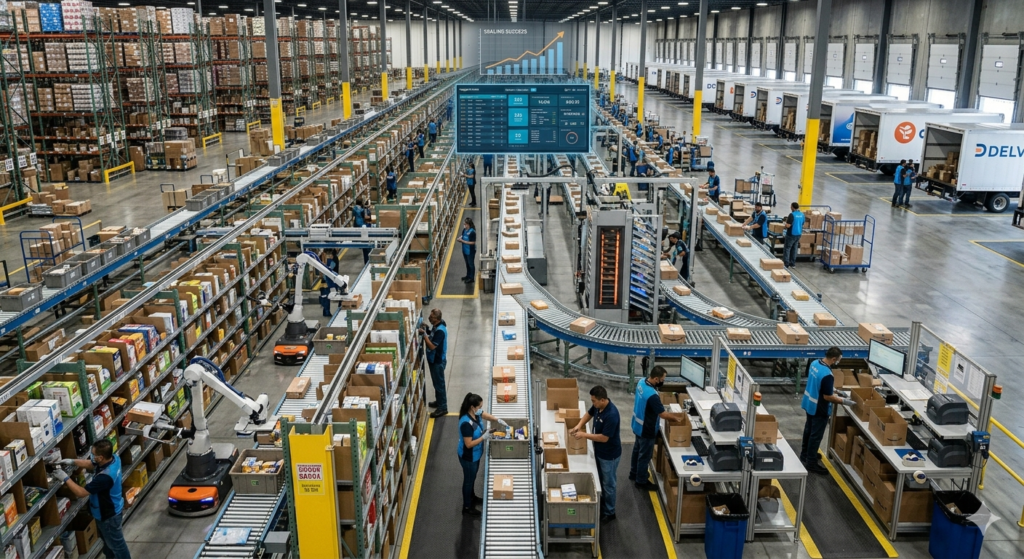
[Insert image of a modern fulfillment warehouse with automated picking and packing stations here]
1. What Are E-Commerce Fulfillment Services?
Simply put, e-commerce fulfillment services handle the entire process of getting products from your warehouse shelf to your customer’s doorstep.
The process typically includes:
- Receiving inventory
- Storing products
- Picking ordered items
- Packing shipments
- Shipping orders
- Handling returns
- Inventory tracking
Think of fulfillment as the backstage crew at a concert. Customers only see the final performance, but a lot happens behind the scenes to make everything run smoothly.
Fulfillment vs Standard Shipping
| Fulfillment Services | Standard Shipping |
|---|---|
| Stores inventory | Transport only |
| Picks products | No inventory handling |
| Packs orders | Delivers packages |
| Manages returns | Limited responsibility |
| Tracks stock levels | Focuses on transportation |
2. When Should You Outsource Order Fulfillment?
Many business owners wait too long before outsourcing.
Here are some warning signs:
You’re Running Out of Space
If products are taking over your garage, spare room, or office, you’ve probably outgrown in-house fulfillment.
Orders Are Increasing Fast
Growth is exciting, but manually packing hundreds of orders every week quickly becomes exhausting.
Shipping Mistakes Are Increasing
Wrong products, delayed shipments, and inventory errors often happen when operations become overwhelming.
You’re Spending More Time Packing Than Selling
Your job should be growing your business, not spending hours with packing tape.
This is where outsourced order fulfillment for small business becomes a game-changer.
3. The Biggest Benefits of Using a 3PL Provider
One of the most common questions I hear is:
“What are the benefits of using a 3PL provider?”
The answer is simple: efficiency.
Key Benefits
✔ Faster shipping
✔ Lower operational costs
✔ Better inventory visibility
✔ Reduced labor expenses
✔ Easier business scaling
✔ Professional logistics management
✔ Improved customer satisfaction
A strong third-party logistics (3PL) partner acts like an extension of your business.
[Insert image showing a business owner reviewing orders while a fulfillment center handles logistics]
4. Understanding Fulfillment Pricing
Many store owners worry that fulfillment services are expensive.
In reality, the cost structure is fairly straightforward.
| Fee Type | What It Covers |
|---|---|
| Receiving Fee | Accepting inventory shipments |
| Storage Fee | Warehouse space used |
| Pick-and-Pack Fee | Selecting and packing products |
| Shipping Fee | Carrier delivery charges |
| Return Processing Fee | Handling returned products |
When evaluating providers, ask for an e-commerce order fulfillment cost calculator to estimate monthly expenses accurately.
5. How Fulfillment Centers Reduce Shipping Costs
Shipping is one of the largest expenses for online stores.
Fortunately, professional fulfillment providers often negotiate discounted carrier rates due to their shipping volume.
Ways They Help Lower Costs
- Bulk carrier discounts
- Multiple warehouse locations
- Automated shipping selection
- Zone optimization
- Packaging efficiency
If you’ve been wondering how to reduce shipping costs for online stores, outsourcing fulfillment can often provide immediate savings.
6. Inventory Management Is Easier Than Ever
Modern fulfillment companies use advanced Warehouse Management Systems (WMS).
These systems provide:
- Real-time inventory tracking
- Low-stock alerts
- Sales forecasting
- Multi-location visibility
- Automated reporting
Many businesses pair fulfillment operations with the best inventory management software for e-commerce to gain complete visibility across their supply chain.
7. Multi-Channel Fulfillment Integration Matters
Today’s customers shop everywhere.
They buy from:
- Shopify stores
- Amazon
- eBay
- Walmart Marketplace
- TikTok Shop
- WooCommerce websites
This is why multi-channel fulfillment integration has become essential.
A quality fulfillment provider automatically syncs inventory and orders across all sales channels.
No more spreadsheets. No more guessing.
Just accurate data.
8. What About Returns?
Returns are unavoidable in e-commerce.
The good news?
Professional fulfillment companies handle reverse logistics best practices for you.
Return Management Includes:
- Product inspection
- Inventory updates
- Restocking
- Product disposal
- Refund processing support
Effective e-commerce return management strategies can significantly improve customer satisfaction while reducing losses.
9. Can Fulfillment Providers Handle Holiday Rushes?
Absolutely.
One of the biggest advantages of scalable e-commerce logistics for startups is flexibility.
During peak seasons such as:
- Black Friday
- Cyber Monday
- Christmas
- Back-to-school periods
Fulfillment centers can quickly increase staffing and storage capacity.
This allows you to scale without hiring temporary employees yourself.
10. Shared Warehousing vs Dedicated Warehousing
Most small and medium businesses benefit from shared warehousing.
| Shared Warehouse | Dedicated Warehouse |
|---|---|
| Lower cost | Higher cost |
| Flexible space | Exclusive space |
| Ideal for growing brands | Best for large enterprises |
| Pay for what you use | Long-term commitment |
For most businesses, affordable warehousing solutions for Shopify and other platforms come through shared warehouse models.
11. Custom Packaging Builds Stronger Brands
Customers remember experiences.
A plain brown box works.
But a beautifully branded package creates excitement.
Many fulfillment providers offer:
- Custom boxes
- Branded inserts
- Personalized notes
- Kitting services
- Custom labels
These custom packaging for e-commerce brands help create memorable unboxing experiences.
[Insert image of premium branded packaging and product inserts here]
12. Top Fulfillment & Logistics Tools for 2026
Here are some of the most popular tools helping online businesses streamline operations today.
| Tool | Category | Best For |
|---|---|---|
| Shopify | Platform | Online store management |
| BigCommerce | Platform | Enterprise e-commerce |
| ShipStation | Shipping | Shipping automation |
| WooCommerce | Plugin | WordPress stores |
| Zoho Inventory | Inventory | Stock tracking |
| Oracle NetSuite | ERP | Supply chain visibility |
| EasyPost | API | Shipping integrations |
| ShipBob | 3PL | Global fulfillment |
| Flexe | Warehousing | Flexible storage |
| Stord | Logistics | Distributed fulfillment |
These platforms support automated order processing systems that save time and reduce errors.
13. Global Distribution and Freight Solutions
Many brands eventually expand internationally.
This creates new challenges:
- Customs compliance
- International shipping rates
- Regional warehouses
- Tax regulations
Modern providers offer global distribution and freight solutions that help businesses serve customers worldwide without managing international logistics themselves.
14. Cold Chain Fulfillment Services
Not all products can sit on a shelf.
Certain industries require temperature-controlled storage.
Examples include:
- Food products
- Supplements
- Pharmaceuticals
- Cosmetics
Specialized cold chain fulfillment services maintain product quality from warehouse to customer.
15. The Future of E-Commerce Fulfillment
The fulfillment industry is evolving rapidly.
Emerging trends include:
- AI-powered inventory forecasting
- Robotics and automation
- Same-day delivery networks
- Sustainable packaging
- Real-time tracking updates
Consumers expect faster shipping than ever before, making efficient logistics a competitive advantage rather than a luxury.
Frequently Asked Questions (FAQs)
What is e-commerce fulfillment and how does it differ from standard shipping?
Fulfillment covers inventory storage, order picking, packing, shipping, and returns management. Shipping only handles transportation.
How do I know when it’s time to outsource fulfillment?
When order volume becomes difficult to manage internally or begins affecting customer experience.
How is fulfillment pricing structured?
Most providers charge for receiving inventory, storage, pick-and-pack services, shipping, and returns processing.
Can fulfillment providers integrate with Shopify or WooCommerce?
Yes. Most modern providers offer direct integrations and APIs.
How are product returns handled?
Fulfillment centers manage reverse logistics, including inspection, restocking, disposal, and inventory updates.
What ensures order accuracy?
Barcode scanning systems, automation, and warehouse management software help minimize mistakes.
Can providers handle seasonal spikes?
Yes. Reputable 3PL providers are built to scale during busy periods.
Do I need a dedicated warehouse?
Not usually. Shared warehousing is more affordable and suitable for most growing businesses.
How can I track inventory in real time?
Through warehouse management dashboards that sync directly with your online store.
Do fulfillment services offer branded packaging?
Many providers offer custom packaging, inserts, labels, and kitting services.
Final Thoughts
The best online stores aren’t necessarily the ones with the biggest marketing budgets. They’re often the businesses with the smoothest operations.
By investing in professional e-commerce fulfillment services, you can reduce shipping headaches, improve customer satisfaction, lower operational costs, and free up valuable time to focus on growth.
Whether you’re a startup packing orders from your garage or an established brand preparing for global expansion, the right order fulfillment solutions can transform how your business operates.
The question isn’t whether fulfillment matters.
